
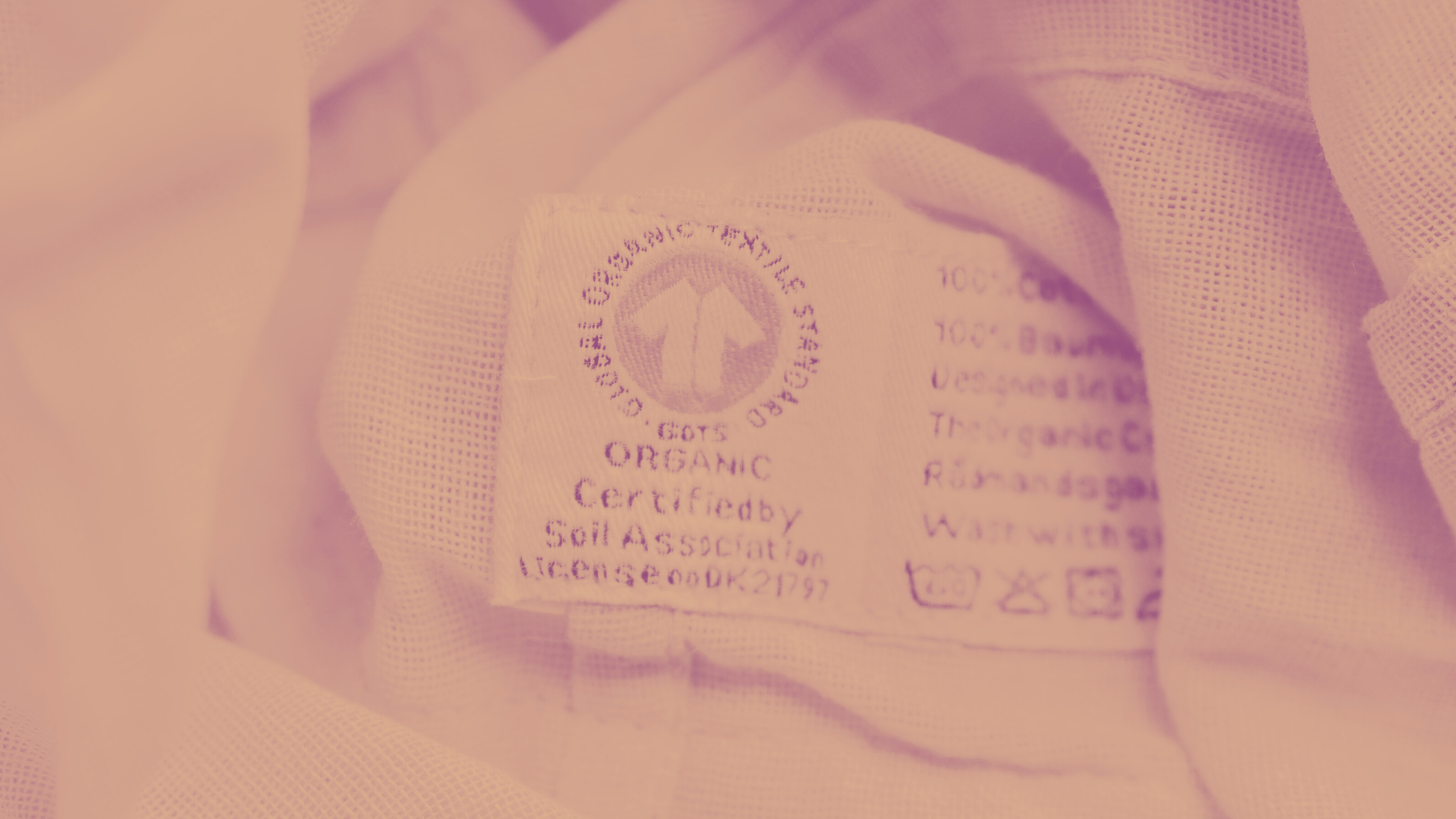
ertifications have become part of the everyday language of sustainable fashion. They’re often printed on tags or listed in product descriptions—short phrases that suggest care, ethics, or responsibility.
But behind each label is a specific set of standards—and not all of them mean the same thing. Some focus on materials, others on working conditions or chemical safety. Some are independently verified, while others are created by brands themselves.
Rather than taking them at face value, it’s worth understanding what these certifications actually represent. Because when we know what a label stands for, we can choose with more clarity—and a little more confidence.
GOTS — Beyond Organic Cotton
The Global Organic Textile Standard (GOTS) is often the first label people encounter when stepping into sustainable fashion. It signals more than just the use of organic fibres—it covers environmental and social standards throughout the entire textile production process.
To qualify, a product must contain at least 70% certified organic fibres (95% for the highest tier), and processing must exclude harmful chemicals, heavy metals, and toxic dyes. GOTS also requires proper wastewater treatment and includes social criteria like safe working conditions, no child labour, and fair treatment of workers.
However, GOTS doesn’t certify an entire brand, only specific products. And while it addresses both ecological and labour concerns, it doesn’t cover everything—carbon footprints, for instance, are outside its scope. Still, it’s one of the most comprehensive signals that a garment was made with care at multiple stages.

Organic Content Standard (OCS) — Verifying Organic Fibres, Simply
The Organic Content Standard (OCS) tracks and verifies the presence of organically grown fibres in a final product. Overseen by Textile Exchange, it confirms that the raw material used—such as organic cotton—was produced according to organic farming principles. It offers two versions: OCS 100, for items made with 95–100% organic fibres, and OCS Blended, for those with at least 5% organic content mixed with conventional fibres.
Unlike GOTS, which sets requirements for the entire production process (including dyes, chemicals, and worker welfare), OCS focuses solely on verifying content. It doesn’t include social or environmental criteria beyond the farm stage, nor does it regulate the processing of materials into finished textiles.
Still, for brands that are early in their sustainability journey—or those that want to provide transparency around organic content without the complexity of full certification—OCS can be a valuable step. It says, at minimum: the organic fibre is really there.

Better Cotton — Progress in a Compromised System
Better Cotton, formerly known as the Better Cotton Initiative (BCI), is one of the most widely used cotton sustainability standards in the world. Unlike GOTS, it does not require organic farming. Instead, it aims to make conventional cotton production less harmful by promoting improved farming practices at scale.
Through training and partnerships, Better Cotton works with farmers to reduce water and pesticide use, improve soil health, and encourage fairer labour practices. It operates primarily through a mass balance system, meaning that Better Cotton may be mixed with conventional cotton in the supply chain—but the overall investment supports better practices over time.
While this model helps bring basic sustainability practices into large-scale production, it has notable limitations. Because it allows blending, consumers can’t be sure that their specific garment contains Better Cotton. The standard also does not prohibit genetically modified seeds and offers weaker guarantees on worker protections compared to Fair Trade or GOTS.
Better Cotton is best understood as a step in a longer journey—not a guarantee, but a shift toward better outcomes within a deeply flawed system. For brands producing at scale, it may be a starting point. For conscious consumers, it’s a label worth reading with context in mind.

Fair Trade — Centering People and Dignity
Unlike GOTS, which starts in the soil, Fair Trade begins with the people. This certification ensures that workers are paid fair wages, operate in safe conditions, and benefit from community development funds. It’s particularly relevant in regions where labour rights are fragile and exploitation is common.
Fair Trade Certified products often come from cooperatives or producer groups, where democratic decision-making is encouraged. In fashion, it usually applies to cotton farmers or sewing facilities. But Fair Trade doesn’t always include environmental standards—those need to be addressed separately.
Its real strength lies in human dignity: it’s a label that says, “someone’s wellbeing was considered here.”

OEKO-TEX — Protecting the Wearer
OEKO-TEX® Standard 100 focuses on the end of the supply chain: the finished garment. It ensures that textiles are free from substances that could harm human health, such as carcinogenic dyes, formaldehyde, or heavy metals.
This certification applies to every component of a product—zippers, threads, buttons. It doesn’t account for how or where the item was made, nor does it evaluate sustainability in a broader sense. But it plays a valuable role in ensuring that what touches our skin is safe to wear.

PETA-Approved Vegan — Animal-Free Assurance
The PETA-Approved Vegan label is a growing presence in ethical fashion, especially as more consumers look for animal-free alternatives. Overseen by People for the Ethical Treatment of Animals (PETA), this certification verifies that a product does not contain any animal-derived materials—no wool, silk, leather, feathers, or animal-based glues or dyes.
It’s a straightforward label, designed primarily for transparency around vegan fashion choices. Brands that receive the approval can display the logo on certified items, signalling to customers that their purchases are free from animal exploitation.
However, the certification doesn’t account for labour conditions, environmental impact, or synthetic alternatives. A PETA-approved bag may be free from leather, but still made from petroleum-based plastic, or produced under exploitative factory conditions. This doesn’t make the certification meaningless—but it does invite more thoughtful evaluation.
PETA-Approved Vegan is best understood as a single-issue label. It helps consumers identify animal-free products quickly.

Bluesign® — Cleaning Up the Process
Bluesign® certification takes a systems-level view of textile production. Rather than testing the final product, it focuses on inputs—ensuring that harmful substances never enter the manufacturing process at all. It also looks at energy and water efficiency, factory safety, and chemical management.
Bluesign doesn’t require organic materials, and it doesn’t guarantee fair wages or strong labour rights. Still, for brands working to clean up their supply chains at the industrial level, it offers rigorous tools for better environmental performance.

Fair Wear Foundation — Accountability in Practice
The Fair Wear Foundation works directly with clothing brands to improve labour conditions in garment factories, especially in countries where protections are limited. It’s not a product label, but a brand-level initiative based on continuous improvement.
Brands that join Fair Wear commit to its Code of Labour Practices, covering things like fair wages, reasonable working hours, and the right to unionise. The foundation performs regular audits and publishes performance checks, holding brands accountable through transparent reporting.
It doesn’t guarantee perfection—but it encourages active responsibility, rather than passive compliance. For consumers, the Fair Wear label signals that a brand is engaging seriously and publicly with labour rights issues.

B Corp — Whole Business Accountability
B Corp is a business-level certification that applies not to individual products but to the entire company. It measures how a brand performs across governance, employee treatment, environmental practices, and community impact.
To become a B Corp, companies must undergo a detailed assessment and commit to balancing purpose with profit. In fashion, this means that while not every item might be sustainable, the company is making efforts across its operations.
That said, B Corp allows brands to score points in different categories, which can sometimes lead to inconsistency across industries. Still, it’s a meaningful step for companies trying to build long-term impact into their business model.

In Closing
Certifications aren’t a finish line. They’re part of an evolving map. For those of us trying to wear our values, they offer markers of intention and effort. Not every brand can afford every certification. Not every factory meets every standard. But these labels give us something to look for—something to ask about—something to build from.
This post reflects my current understanding, and it’s also part of my own ongoing learning. If there are certifications you feel are missing, or if you see some of these differently, I’d truly welcome your thoughts. Let’s treat this as a shared space for conversation—where we can explore, question, and learn together.