
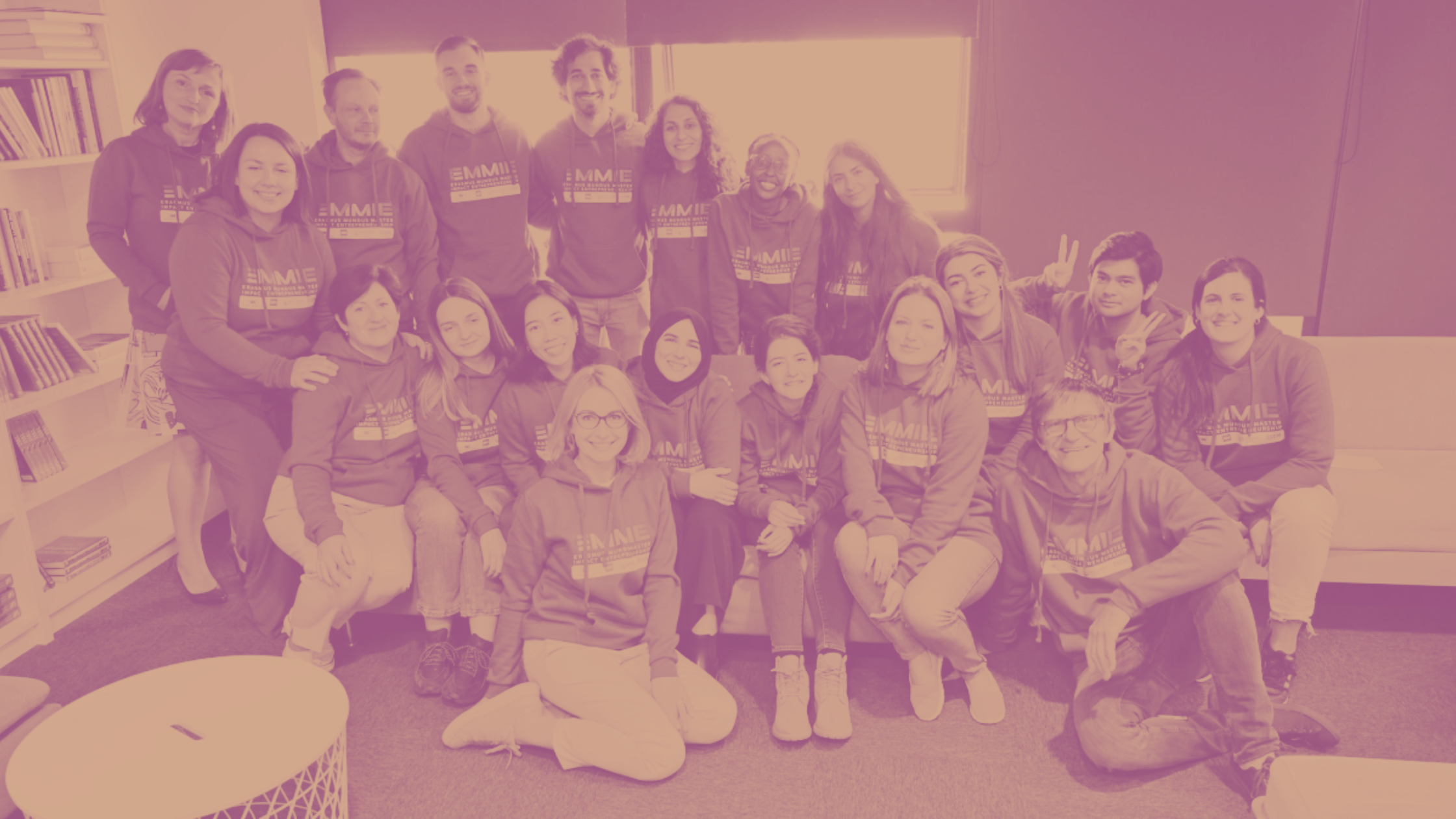
In 2023, I was selected for the Erasmus Mundus scholarship, through the EMMIE programme.
At the time, what stood out was not the academic promise alone, but the structure of the programme itself. Learning happened across multiple European countries, alongside classmates who came from different parts of the world, carrying different professional and cultural reference points. The value of this kind of education was not only in lectures or frameworks, but in movement, across borders, conversations, and assumptions.
Studying in this way created a constant exchange. People learned about each other’s contexts, constraints, and motivations. Over time, this exposure did something subtle but important: it widened perspective while sharpening self-reflection. Work that once felt self-evident began to look different when placed next to other realities.
When education meets a very practical tension
This programme made sense to me not as a beginning, but as a continuation of work already in motion.
Coming from a volunteer-led, non-profit background, the challenge was no longer whether social and environmental impact mattered — that part was clear. The real question was how to transition an organisation toward financial sustainability without losing its purpose.
Turning impact-driven work into something revenue-generating is rarely straightforward. Profitability brings pressure. It introduces trade-offs, power dynamics, and the risk of mission drift. Working with volunteers added another layer of complexity: how to make a transition without exploiting goodwill, and how to design payment models that are fair, transparent, and aligned with limited resources.
Questions emerged around spin-offs, selective paid roles, and project-based compensation, not as abstract business exercises, but as ethical design problems.
Europe as a place to test assumptions
Relocating to Europe opened up a different set of possibilities.
There was space to explore whether products developed in a Global South context could access markets with higher margins, and what that would mean for the people involved in production. At the same time, it made visible the less romantic side of internationalisation: shipping costs, logistics, environmental trade-offs, and the contradictions embedded in “scaling impact” across continents.
The programme did not provide ready-made answers. Instead, it created a setting where these tensions could be examined more honestly, with peers who were facing similar dilemmas in different sectors and regions.
Who this programme tends to serve best
This programme may not be for everyone.
It can be particularly challenging for those whose project ideas are still entirely unformed. This does not mean that applicants need to have already launched an organisation, but it does help to arrive with a reasonably clear sense of direction, an idea of what kind of product or service might be developed, what social or environmental issue it responds to, and how value might eventually be generated.
It is also worth recognising that the programme is firmly situated in a European context. Much of what is learned, from networks and partnerships to funding opportunities — is shaped by EU-based ecosystems. Projects that are entirely detached from this context may struggle to fully engage with what the programme offers.
On coherence
Arriving at the programme with an already established non-profit project made it possible, in my case, to speak concretely about the work. What had been done, why it existed, and how it functioned could be described in detail, including impact goals, revenue flows, and constraints.
From that position, specificity mattered. Being able to reference documented outcomes, such as materials recovered, people involved, compensation paid, revenue generated, or funding sources accessed, added clarity and credibility. Media coverage and public recognition helped, not as decoration, but as signs that the work had already moved beyond intention.
At the same time, visibility alone proved insufficient. A profile filled with achievements disconnected from impact entrepreneurship can read as accumulation rather than commitment. What seemed to matter more was coherence — when a CV, a project, and a motivation pointed in the same direction, suggesting sustained curiosity, passion and intentionality rather than opportunism
A note for those considering applying
For those interested in applying, practical information about the programme and application process can be found on the official website.
What mattered most in my experience was consistency across the application as a whole — in the story being told.
This meant ensuring that experiences listed in the CV clearly related to the project and direction described elsewhere. The motivation letter became a space to add context: to explain decisions, learning moments, and reasoning that a CV alone cannot capture. Rather than repeating achievements, it helped to reflect on experience, gaps, and how this programme could meaningfully support the next stage of work.
The entrepreneurial project description benefited from being concrete. Articulating the problem addressed, the intended impact, and the economic logic — including what had already been tested and what remained uncertain — made the proposal feel grounded rather than aspirational.
Referees also mattered. The most relevant references were those who had worked closely with me and could speak directly to the project and trajectory being presented.
Taken together, the application worked best when it told a single, coherent story over time: what had been done, what had been learned, where the work currently stood, and how this programme could help bridge the gap between intention and practice.